Mexico is one of the largest economies in Latin America and a key manufacturing hub within North American value chains under the United States-Mexico-Canada Agreement (USMCA). Industrial growth—particularly in automotive, electronics, steel, and logistics—together with nearshoring trends, continues to drive electricity demand.
In 2023, electricity generation reached approximately 351 TWh, while consumption increased by around 3–4% compared to the previous year [1]. Long-term projections indicate continued demand growth, with electricity consumption expected to increase significantly toward 2038, reflecting sustained industrial expansion and electrification trends [2].
This development is increasing pressure on generation capacity, transmission infrastructure, and system reliability, particularly in industrial regions. Mexico’s strong solar resource and the economics of photovoltaic systems provide favorable conditions for scaling solar energy as part of future capacity expansion.
Mexico is located within the so-called Sun Belt and benefits from some of the highest solar resources in North America. Figure 1 shows the long-term average photovoltaic power potential (PVOUT) across the country, expressed in kWh/kWp.
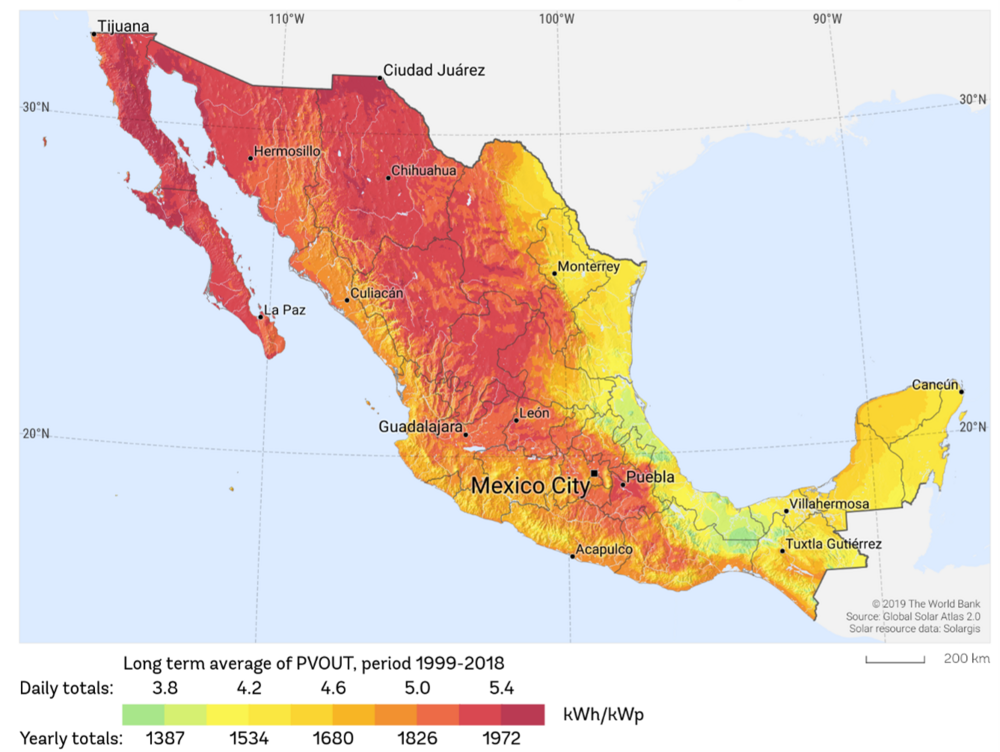
The highest solar resources are found in northern and northwestern Mexico, where annual PV yields can exceed 2,000 kWh/kWp. Even regions with comparatively lower solar irradiation, particularly in southeastern Mexico, typically achieve annual yields above 1,300 kWh/kWp.
For comparison, typical photovoltaic yields in southern Germany range between 1,000 and 1,100 kWh/kWp. This highlights Mexico’s strong natural advantage for solar energy generation and helps explain the rapid growth of both utility-scale and distributed photovoltaic installations.
Mexico’s energy transition is evolving within a hybrid framework that combines renewable energy deployment with a strong strategic role for the state utility Comisión Federal de Electricidad (CFE).
Current policy frameworks emphasize energy security, system reliability, and capacity expansion. At the same time, regulatory developments continue to shape investment conditions, including frameworks for private participation and mixed public-private generation models.
Recent constitutional and regulatory reforms have reinforced the role of the state in the electricity sector. Under the current framework, CFE is expected to maintain participation in at least 54% of electricity generation, while private companies continue to participate through various generation, investment, and partnership schemes. This approach seeks to balance energy sovereignty objectives with the need for continued investment in generation capacity, grid infrastructure, and clean energy technologies.
Electricity demand in Mexico is expected to grow steadily over the coming decades. Industrial and commercial consumers account for more than 70% of total electricity demand, underlining the importance of reliable and cost-efficient supply[1].
At the same time, the system faces structural constraints:
Planning scenarios project substantial additions to generation capacity, transmission infrastructure, and system integration measures in order to meet demand growth and maintain system stability[2].
Solar photovoltaic energy has become one of the fastest-growing technologies in Mexico’s electricity system and is increasingly contributing to meeting incremental demand.
In 2024, approximately 1.6 GW of new PV capacity was installed, bringing total installed capacity to around 12.6 GW [4]. Distributed generation represents a significant share of this expansion, with annual additions exceeding 1 GW, driven mainly by commercial and industrial consumers [4].
Long-term planning scenarios continue to foresee significant solar deployment. According to PRODESEN 2024–2038, solar PV remains one of the main technologies expected to contribute to future capacity additions, with approximately 8.8 GW of additional utility-scale PV capacity projected between 2028 and 2038, alongside continued growth in distributed generation.
Key drivers for solar PV deployment include:
While utility-scale solar remains relevant, its development is closely linked to grid availability and permitting conditions. In contrast, distributed PV provides a flexible option to meet demand locally, reducing reliance on transmission expansion.
Solar PV is therefore emerging as a central component of Mexico’s evolving energy system, contributing to both demand coverage and cost-efficient electricity supply.
With the increasing integration of variable renewable energy sources, energy storage is gaining importance in Mexico’s electricity system.
Although deployment is still at an early stage, recent policy developments indicate a clear expansion trajectory:
These developments reflect a gradual transition of storage technologies from pilot applications toward a defined role in supporting grid stability, renewable integration, and peak load management.
Hydrogen and Power-to-X technologies are being explored as part of Mexico’s long-term decarbonization strategy, particularly in industrial sectors. Current initiatives focus on early-stage project development and strategic assessment. Large-scale deployment will depend on future regulatory frameworks, infrastructure development, and cost reductions.
Despite favorable renewable resources and growing electricity demand, Mexico’s energy transition faces several structural challenges:
These factors are particularly relevant in regions experiencing rapid industrial growth, where electricity demand is increasing faster than infrastructure expansion.
In addition to electricity generation, Mexico has favorable conditions for solar thermal applications across residential, commercial, and industrial sectors. The country is one of the leading solar thermal markets in Latin America and has developed a particularly strong position in industrial solar heat applications, supported by high solar irradiation, significant hot water demand, and growing interest in industrial decarbonization. Solar thermal technologies can contribute to the supply of low- and medium-temperature heat in industries such as food processing, mining, and tourism. These applications offer opportunities for reducing fossil fuel consumption and supporting sectoral decarbonization.
The market is supported by a range of policy and financing mechanisms, including building standards, municipal requirements, financing programs, and tax incentives that encourage the adoption of solar water heating systems. In several residential, hospitality, and commercial applications, payback periods can range from one to five years, supporting continued market deployment. These factors, combined with Mexico’s high solar irradiation, position solar thermal technologies as a complementary solution for reducing fuel consumption and emissions in the heat sector.
Sources:
Globally, battery energy storage systems (BESS) are becoming a central component of modern electricity systems. As renewable energy deployment accelerates, batteries support the integration of variable solar and wind generation, improve grid flexibility, reduce network congestion, enhance system reliability, and enable more efficient use of existing infrastructure.
According to the International Energy Agency (IEA), battery storage is currently the fastest-growing clean energy technology in the power sector and is expected to play a critical role in supporting secure and cost-effective energy transitions worldwide.[1]
In Mexico, storage is becoming increasingly relevant as electricity demand grows, industrial activity expands, and renewable energy deployment accelerates. Battery systems can support renewable integration, peak demand management, industrial reliability, grid balancing, and hybrid PV-plus-storage applications.
Mexico's storage market is still at an early stage compared to more mature markets, but recent developments indicate a clear transition from pilot projects toward large-scale deployment and system planning.
In 2026, Mexico identified an indicative requirement of approximately 935 MW of standalone battery storage capacity distributed across seven regional control areas, with most projects expected to provide around three hours of storage duration and enter operation before 2030.[2]
This requirement reflects the growing need for flexibility within the Mexican electricity system, particularly in regions experiencing rapid industrial growth, increasing renewable penetration, and transmission constraints.
As renewable generation continues to expand, storage is increasingly viewed as a strategic tool for improving system reliability, supporting grid stability, and facilitating the integration of additional renewable capacity.
Mexico's commercial and industrial electricity tariffs create attractive opportunities for battery storage deployment.
Several industrial tariff categories administered by Comisión Federal de Electricidad (CFE), including GDMTO and GDMTH tariffs, incorporate demand charges and time-dependent electricity pricing structures.[3]
For commercial and industrial consumers, battery systems can provide multiple benefits:
These applications are particularly attractive for energy-intensive industries and facilities where power reliability and electricity cost management are critical business factors.
The global growth of battery storage is closely linked to the rapid development of lithium-ion technologies, particularly lithium iron phosphate (LFP) and other chemistries used in stationary storage and electric mobility applications.
Mexico's strong automotive and manufacturing base creates opportunities for battery assembly, component manufacturing, and supply-chain integration. Recent investments in high-voltage battery assembly for electric vehicles demonstrate Mexico's growing importance within the North American battery value chain.[4]
At the same time, Mexico continues to advance initiatives related to strategic minerals and battery supply chains through institutions such as LitioMx, created to support the development of the country's lithium resources.
While the battery manufacturing ecosystem is still evolving, opportunities are emerging across battery assembly, system integration, energy storage deployment, and industrial applications. Together with Mexico's strong manufacturing base and increasing demand for energy storage solutions, these developments could support the country's long-term participation in the regional battery industry.
Mexico has recently taken important steps toward establishing a formal legal framework for electricity storage.
In April 2026, the Comisión Nacional de Energía (CNE) published General Administrative Guidelines for the integration of Electric Energy Storage Systems (SAEE) into the National Electric System.[5]
The new framework recognizes multiple participation models for storage, including:
The framework also establishes requirements related to permits, operation, measurement, and participation within the electricity market.
Although implementation details and market mechanisms will continue to evolve, storage now has a defined legal place within Mexico's electricity sector. This represents an important milestone for project developers, investors, industrial users, and technology providers.
Battery storage is expected to play an increasingly important role in Mexico's long-term energy transition.
As renewable energy deployment expands, storage technologies can help increase renewable penetration while maintaining system reliability and operational flexibility. Batteries also support electrification strategies by enabling greater use of renewable electricity and reducing dependence on fossil-fuel-based generation during peak demand periods.
Recent international studies consistently identify storage as a key enabler of decarbonized electricity systems. For Mexico, where electricity demand is expected to continue growing due to industrial expansion, nearshoring, and electrification, storage can become an important component of future system development.[1][6]
Beyond supporting renewable integration, batteries can contribute to grid modernization, resilience, congestion management, and the efficient use of transmission infrastructure.
Energy storage in Mexico is transitioning from an emerging technology discussion toward a defined market opportunity.
Recent regulatory developments, growing industrial demand, increasing renewable deployment, and evolving system requirements are creating a stronger foundation for battery storage projects across the country.
For ees Mexico, this creates an opportunity to bring together technology providers, project developers, industrial users, regulators, investors, and researchers working on storage, flexibility, renewable integration, and the future of Mexico's electricity system.
Sources