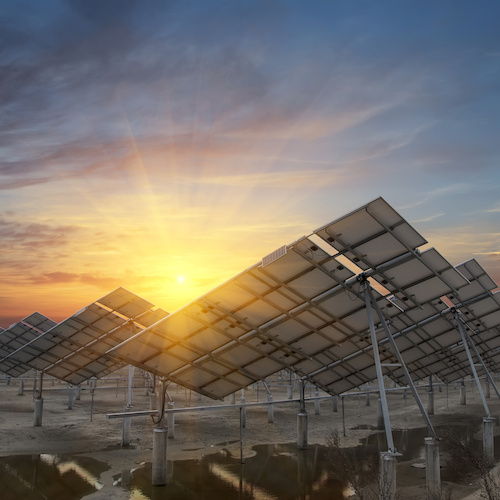
México es uno de los países mejor preparados para satisfacer la creciente demanda de electricidad y calor con energía solar. Según el grupo de expertos EMBER, la energía solar combinada con baterías podría cubrir con éxito el 90 por ciento de la demanda total de electricidad de México, dejando solo un 6 por ciento de excedente de suministro. Actualmente, México tiene la segunda mayor industria de energía solar en América Latina, con 12.6 gigavatios (GW) de capacidad fotovoltaica (PV) instalada a finales de 2024, según la Asociación Mexicana de Energía Solar ASOLMEX.
Sin embargo, EMBER indica que solo el 7.7 por ciento de la electricidad producida en 2024 fue solar. Para alcanzar los objetivos de energía limpia de México, que son del 38 % de electricidad limpia para 2030 y 45 por ciento para 2035, el gobierno está intentando acelerar el despliegue de la energía fotovoltaica.
Tras un decreto de octubre de 2025, que establece normas más claras para las inversiones privadas, surgieron en el mercado diferentes propuestas de PV y baterías a gran escala, dominadas por las actividades de la empresa estatal mexicana CFE. Al mismo tiempo, México es un mercado en auge para la energía solar térmica: con 4.5 gigavatios térmicos (GWth), también es el segundo mercado más grande de América Latina para la energía solar térmica, con un excelente crecimiento empresarial en nichos como el calor solar de procesos.
El Plan de Desarrollo del Sector Eléctrico (PLADESE) 2025-2039 de la Secretaría de Energía (SENER) prevé casi 25 GW de nueva capacidad de energía limpia para 2030, incluyendo energías renovables y almacenamiento, con la energía solar representando la mayor parte de las nuevas incorporaciones. El desarrollo del mercado sigue una estructura dual: los proyectos fotovoltaicos a gran escala están estrechamente vinculados a la expansión de la red y a la participación del sector público a través de la empresa estatal CFE, mientras que la generación distribuida sigue expandiéndose gracias a la inversión privada impulsada por la economía del autoconsumo.
El sector de la energía solar térmica creció constantemente durante las últimas décadas, alcanzando la tasa de crecimiento anual más alta a nivel mundial en 2024 con un 14 por ciento, según el informe «Solar Heat Worldwide» de la plataforma tecnológica IEA SHC.
La incertidumbre jurídica y los mayores costos de los sistemas fotovoltaicos a gran escala son los principales obstáculos para una aplicación más rápida de la energía solar en México. Con el fortalecimiento del papel de la empresa estatal mexicana CFE en la planificación y generación de electricidad mediante un nuevo plan de inversión mixta para la generación de energía renovable, que exige una participación directa o indirecta mínima del 54 por ciento por parte de la CFE, ha aumentado la incertidumbre jurídica para el capital privado. Esto eleva los costos operativos y socava la competitividad en el mercado global.
Los costos comparativamente más elevados de las plantas fotovoltaicas son otro reto para México: EMBER afirma que, según datos de la Agencia Internacional de Energías Renovables (IRENA) y la CFE, «los costos de la energía solar en México son un 38 por ciento más elevados y los de las baterías casi el doble del nivel mundial». Al mismo tiempo, el marco de planificación vinculante de México, PLADESE, apunta a un considerable potencial de crecimiento para la energía solar. Además, el nuevo umbral de 0.7 megavatios (MW) exento de permiso y la simplificación de los permisos para proyectos de autoconsumo de 0.7 a 20 MW podrían impulsar un crecimiento más rápido de la energía fotovoltaica comercial e industrial detrás del medidor.
En cuanto al calor solar, la competencia con el gas estadounidense y el incumplimiento de los objetivos de descarbonización para el sector del calor son desafíos que dificultan una implementación más amplia. No obstante, el tiempo de amortización de los sistemas de calefacción solar en el sector comercial e industrial oscila entre 2 y 4 años con colectores de fabricación local.
México es un actor destacado a nivel global en el ámbito de la energía solar térmica para procesos industriales (SHIP), aunque este segmento sigue siendo un nicho a nivel mundial. Los datos de Solrico muestran que México ha instalado al menos 273 plantas SHIP desde 2016, la cifra más alta a nivel mundial; en 2024 se añadieron 22 plantas con un total de 2.6 MW (cuatro más que en 2023). Cabe destacar que cuatro proveedores mexicanos de SHIP llave en mano han entregado más de 10 instalaciones cada uno.