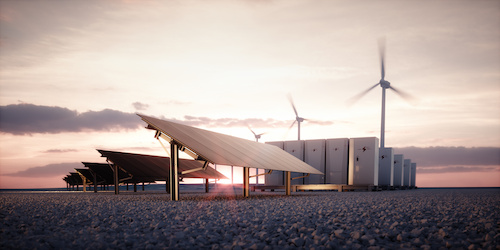
Since the early 2010s, when lithium-ion technology first began to scale beyond consumer electronics into electric vehicles and grid applications, battery storage has evolved from a niche innovation into a versatile “enabling technology” with truly disruptive potential for the global renewable energy transition. As solar and wind power expand at record pace, storage has emerged as the essential counterpart allowing the full exploitation of their generation potential and seamless integration into the electricity grid.
Without Battery Energy Storage Systems (BESS), the continued growth of photovoltaics would face its natural limits: when sunlight is abundant, excess generation must be stored to maintain grid stability and supply electricity when demand peaks. By capturing surplus solar power and releasing it at the right time, batteries turn variable renewable energy into reliable supply. They enhance system flexibility, reduce transmission losses, defer costly transmission upgrades and relieve network congestion.
A wide range of battery chemistries has emerged to meet different performance, cost, and sustainability needs. Lithium-iron-phosphate (LFP) and nickel-manganese-cobalt (NMC) batteries currently dominate, while sodium-ion and solid-state technologies are advancing quickly. According to the market study “Renewable Power Generation Costs in 2024” of the International Renewable Energy Agency (IRENA), the cost of utility-scale BESS dropped to 192 US dollar per kWh in 2024, which is a 93% decline since 2010, driven by industrial scale-up, improved materials and production efficiencies. Complementary storage technologies such as flow batteries, thermal storage, pumped hydro and green hydrogen continue to expand the portfolio of flexible energy solutions.
IRENA highlights that since 2018, energy shifting, which consists in large-scale BESS storing and injecting electricity according to price signals, grid load and current supply and demand, has become the primary application for BESS, accounting for 68% in 2024. It is followed by residential use with 13%, ancillary services with 6% and commercial and industrial use with 5%. The ability to combine multiple value streams (arbitrage, ancillary services, capacity reserve) is making storage projects more bankable and attractive to investors.
Hybridization is a key trend that combines renewable generation sources and with BESS. In the United States, for example, 55% of new solar installations are now hybrid systems combining photovoltaics and BESS. These configurations reduce project development costs, minimize land use and grid connection expenses, and enable higher utilization of solar assets. Across emerging markets, hybrid PV systems are gaining traction as cost-effective solutions to balance variable generation and improve energy access.
The global BESS market continues its exponential rise. According to market intelligence firm Rho Motion, global BESS installations increased by 54% in 2025 compared with the first half of 2024. Annual capacity additions for BESS grew from just 0.1 gigawatt hours (GWh) in 2010 to 169 GWh in 2024, with China (84 GWh) and the United States (41 GWh) leading the charge. Rho Motion forecasts the market to expand at a compound annual growth rate (CAGR) exceeding 20 percent through 2030, with annual installations expected to reach 100 GW by the end of the decade. BloombergNEF predicts that worldwide installed capacity will surpass 1 terawatt-hour (TWh) by 2030.
With costs falling, performance improving, and policy frameworks aligning, BESS is truly the Swiss Army knife of the energy transition, delivering flexibility and reliability for the further expansion of renewables worldwide.