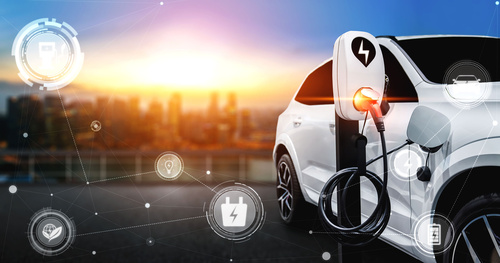
The historical rise of e-mobility took some time. While there were already 34,000 electric vehicles on the road in the US around 1900, it took over 100 years after the combustion engine displaced the early electric vehicle (EV) application for the proper industrial revolution of electric vehicles to take place. Since 2010, electric mobility has grown so quickly that it is reshaping both the automotive industry and the electricity system.
What began as a niche technology has entered mass production: the Nissan LEAF, launched in 2010, is often cited as the first mass-market EV, while Tesla's ramp-up of production of the Model 3 from 2017 helped to firmly establish EVs in the mainstream. Today, e-mobility is about more than just vehicles. It is increasingly an infrastructure and energy integration story, with charging, grid connection and power electronics becoming decisive factors.
The unique selling point of e-mobility is efficiency. In his book “Strom” (Electricity), author Tim Meyer points out that in combustion engines, about 60 percent of primary energy is lost as waste heat. By contrast, in electric applications the efficiency of the full chain “from the electricity source to the road” averages over 70 percent. Meyer argues that this is why each kilowatt-hour (kWh) of wind or solar electricity can displace roughly 3 kWh of oil or natural gas in practical energy terms. In addition, e-mobility can draw on renewable resources for power generation, which are not subject to the same physical scarcity as fossil fuels. As EV adoption grows, the charging ecosystem is shifting from “how many plugs” to “how many kilowatts.” The IEA highlights that public charging capacity must expand rapidly; fast charging is scaling particularly quickly, and ultra-fast charging is gaining share while hardware costs fall. For infrastructure players, this means larger grid connections, stronger power electronics and higher operational reliability.
Electrifying road transport is central to decarbonization because wind and solar electricity can be used directly as drive energy. Beyond CO₂ reductions, EV batteries can also support grid stability and create a new source of system flexibility: with smart and bidirectional charging, vehicles can smooth peaks, absorb surplus renewable generation, and better align variable supply with demand. The IEA notes that China’s V2G standardization efforts could enable EVs to provide around 10 GW of flexible capacity by 2030. In the United States, NREL estimates that bidirectional charging could add about 90 GW of dispatchable power and 540 GWh of shiftable energy by 2030.
Global EV uptake is now measured in tens of millions per year. According to the recent edition of IEA´s Global EV Outlook, in 2024 more than 17 million electric cars were sold worldwide (over 20 percent of new-car sales globally), and sales are expected to exceed 20 million in 2025, with China alone surpassing 14 million. Industrial scale follows demand: around 17.3 million EVs were produced globally in 2024. Heavy-duty electrification is also accelerating: over 90,000 electric medium- and heavy-duty trucks were sold in 2024, and global e-bus sales exceeded 70,000 both trends that raise the importance of depot charging, corridor hubs, and eventually megawatt-class charging solutions. IEA states that electric two- and three-wheelers are another high-volume electrification segment: in 2024, about 10 million electric 2/3Ws were sold worldwide, corresponding to a 15 percent global sales share. The IEA also describes 2/3Ws as the most electrified road-transport segment in 2024, with more than 9 percent of the global 2/3W fleet already electric.